Status · Bill Introduced
Bill · H.R. 8628
Congress · 119th · 2d Sess.
Sponsor · Roy (R-TX)
Filed · 04 · 30 · 2026
New Legislation · 119th Congress · April 30, 2026

U Visa Fraud Machine: Congress Has a Bill to End It.

Rep. Chip Roy (R-TX) introduced the End U Visa Abuse Act, which repeals the statute that created the failed crime-victim visa program — a program that lets illegal aliens accuse U.S. citizens of crimes without notice or opportunity to be heard. The cases below — federal indictments, guilty pleas, USCIS-led investigations — explain why.

Representative Chip Roy (R-TX), sponsor of the End U Visa Abuse Act
Congress should repeal the U visa program in full, as it no longer serves a valid purpose and encourages fraud, rewarding illegal aliens who commit it with the likelihood of a green card and work permit, further enabling lawlessness and illegal immigration...

End U Visa Abuse Act, § 2 Findings
Sponsored by Rep. Chip Roy (R-TX) · H.R. 8628, 119th Cong.

Sources USCIS DOJ GAO DHS OIG Federal Indictments Congressional Record
0
Pending U visa petitions — more than the entire population of Tulsa, OklahomaUSCIS Form I-918, FY25 Q4 (Sep. 30, 2025)
0%
of U visa petitions involved closed cases — no assistance by the alien was neededUSCIS U Visa Fraud and Benefit Integrity Research Study (Feb. 2020), cited in DHS OIG-22-10 (Jan. 2022)
0%
U visa petitioners with a prior arrest for a criminal or immigration offense (filings 2012–2018)Per Vaughan analysis of USCIS FDNS data, Visas for Victims, Center for Immigration Studies (March 2020)

Overview

What Is the U Visa

Congress created the U visa in 2000 as a nonimmigrant benefit for foreign nationals who claim to be victims of qualifying crimes and cooperate with law enforcement. Prior to formal adjudication, it grants deferred action, work authorization, and a smorgasbord of taxpayer benefits. Once approved, it grants nonimmigrant status and a path to citizenship with voting rights.

Eligibility Requirements

A U visa petitioner must prove they: (I) suffered substantial physical or mental abuse from a qualifying crime; (II) possess information about it; (III) have been, are being, or are likely to be helpful to law enforcement; and (IV) are the victim of a crime that violated U.S. law or occurred in the United States. Helpfulness is documented via Form I-918 Supplement B, signed by a federal, state, or local certifying agency.

How It Was Sold

Congress sold the U visa as a crime-fighting tool. The theory: illegal alien victims of qualifying crimes would not cooperate with law enforcement out of fear of deportation. The visa was pitched as the mechanism to unlock victim cooperation, help prosecutors close cases, and protect immigrant communities from predators. Immigrant advocates convinced some “law and order” Republicans to go along with it.

The Problem

Why It’s a Problem

Twenty-Five Years of Failure.

After 25 years, the U visa has not delivered what Congress promised. There is no data proving the U visa has helped solve crimes in any meaningful way. Instead: a 421,000-case backlog, federal indictments of corrupt police and immigration attorneys, staged crimes used to manufacture eligibility, and U.S. citizens secretly accused with no notice or right to respond. The evidence of failure is overwhelming and not accidental. These failures are the natural result of the statutory design itself.

61 percent of law enforcement surveyed stated the program does not significantly improve their ability to investigate and solve crimes, and 54 percent believe petitioners abuse the program — in some cases involving “staged” crimes or “exaggerated injuries.”
— DHS Office of Inspector General (Jan. 2022)

A Statutory Cap in Name Only

Filings Have Exceeded the Cap Every Year Since 2009.

In 2000, Congress set an annual cap of 10,000 U visas. By 2009, filings had already exceeded that cap. By 2024, they had hit 70,941 — more than seven times the statutory limit. The cap has not changed. The backlog now stretches past 421,782 cases — a quarter-century wait at the statutory issuance limit.

Annual U visa petitions filed, FY 2009 to 2025, against the 10,000 statutory cap A bar chart showing annual U visa petitions filed each fiscal year from 2009 through 2025. Filings rose from 10,952 in 2009 to a peak of 70,941 in 2024, with 67,508 filed in 2025. A dashed horizontal line marks the statutory cap of 10,000 visas per year, set by Congress in 2000. Filings have exceeded the cap every year for seventeen consecutive years — by as much as seven-fold. 80,000 70,000 60,000 50,000 40,000 30,000 20,000 0 10,952 70,941 CAP 10,000 ’09 ’10 ’11 ’12 ’13 ’14 ’15 ’16 ’17 ’18 ’19 ’20 ’21 ’22 ’23 ’24 ’25
Filings = principal + derivative petitioners per USCIS Form I-918. Annual U visa petitions filed, FY 2009–2025. Cap of 10,000 set by Congress in the Victims of Trafficking and Violence Protection Act of 2000 and applies to principal-applicant issuances. Source: USCIS Office of Performance and Quality, Form I-918 Number of Petitions for U Nonimmigrant Status by Fiscal Year, Quarter, and Case Status (FY2025 Q4 release).

Fraud Magnet

Why is the U Visa a Fraud Magnet?

The U visa offers an illegal alien one of the only ways to legalize their status, obtain a waiver for past fraud and criminal activity, and secure a path to citizenship, while being showered with endless public benefits.

Deportation Block

The U visa has served as a way to block deportation. Even under the Trump administration, a U visa remains a hurdle to enforcement actions.

8 U.S.C. § 1367, 8 C.F.R. § 214.14(c)(5)(i), ICE Policy 11005.4, ICE Vincent Memo (Sept. 25, 2009)

Taxpayer Funded Lawyers

U visa petitioners get free legal services through organizations funded by the Legal Services Corporation and the DOJ Office on Violence Against Women, from petition through adjudication.

45 C.F.R. § 1626.4(a)(1)

Deferred Action

Granted deferred action — a paperwork check, not a merits review — protecting petitioners from removal years before USCIS adjudicates the underlying claim.

USCIS P.M. Vol. 3, Pt. C, Ch. 5; 8 C.F.R. § 214.14(d)(2)

Path to Citizenship

Approval converts to four-year nonimmigrant status, then a green card after three years, then U.S. citizenship five years after that.

INA § 214(p)(6); INA § 245(m); INA § 316(a)

Chain Migration

Derivative status extends to the principal’s spouse and children, and—if the principal is under 21—their parents and unmarried siblings who were under 18 at the time the initial petition was filed.

INA § 101(a)(15)(U)(ii)

Work Authorization

Issued on the same bona fide determination — before any merits review. Holders can be employed legally anywhere in the United States.

INA § 214(p)(6); USCIS Policy Manual, Vol. 3, Pt. C, Ch. 5

Social Security Card

Issued automatically upon receipt of the work permit, placing the petitioner in federal payroll, tax, and benefits systems before any merits adjudication.

INA § 214(p)(6)

Driver’s Licenses

Receipt of deferred action and work authorization grants temporary “lawful status” for REAL ID purposes. This status, combined with the newly unlocked Social Security Number, facilitates eligibility for standard driver’s licenses in at least 31 states.

REAL ID Act; 6 C.F.R. § 37.3 (state laws vary)

Unemployment Insurance

Work authorization unlocks eligibility for state unemployment benefits, placing applicants on equal footing with U.S. workers once they accumulate the standard authorized base-period wages.

26 U.S.C. § 3304(a)(14)

Waivers for Past Fraud & Crimes

Discretionary waivers cover nearly every ground of inadmissibility—fraud, unlawful presence, murder, rape, child sexual assault, terrorism, espionage. Only four acts are unwaivable: Nazi persecution, genocide, torture, extrajudicial killing.

INA § 212(d)(14)

Healthcare Benefits

Lawfully-present status unlocks ACA marketplace plans with premium subsidies. Some states extend Medicaid/SCHIP to children and pregnant women regardless of LPR status.

45 C.F.R. § 155.20; 26 U.S.C. § 36B; 42 U.S.C. § 1396b(v)(4)(A)

Medicare (Part A)

Deferred action provides the “lawful presence” necessary to access Premium-Free Medicare Part A long before a green card is issued. However, applicants must still meet standard age or disability criteria and possess 40 quarters of covered employment history.

42 U.S.C. § 1395c; 8 U.S.C. § 1611(b)(2)

Food Stamps

SNAP eligibility kicks in upon lawful permanent residency — immediate for U-visa children under 18, but subject to the five-year PRWORA waiting period for adults.

8 U.S.C. § 1612(a); 7 C.F.R. § 273.4

In-State Tuition & Student Aid

In-state college tuition is available in 22+ states, subject to local graduation and residency requirements. Full Title IV federal student aid (Pell Grants, federal loans) officially opens upon adjustment to lawful permanent resident status.

20 U.S.C. § 1091(a)(5); 8 U.S.C. § 1641(b)(1) (state laws govern in-state tuition)

Voting Rights

Full voting rights in federal and state elections are unlocked upon U.S. citizenship. Prior to naturalization, some local governments permit green card holders to vote in local city or school board elections.

INA § 316(a); 8 U.S.C. § 1427(a)

Ten Reasons

Ten Reasons the U Visa Must Be Repealed.

The U visa program is flawed by design. Congress designed the flaws; only Congress can remove them. Here are ten reasons why.

01

No Due Process.

The U.S. citizen accused of a predicate crime receives no notice, no hearing, no right to respond, and no standing to challenge the petition or certification. A fabricated accusation can produce years of pretrial detention and permanent reputational damage. In some prosecutions, the pending U visa application is never disclosed to the defense at all — classic Brady material, as it is direct evidence of the accuser’s motive to lie. The accused has fewer protections than a small-claims defendant.

02

Fraud Magnet.

The U visa dangles a path to U.S. citizenship in exchange for nothing more than an unproven claim of victimhood — an irresistible incentive to fabricate for illegal aliens with no other path to legal status. Evidentiary standards are minimal, the administrative trial is held in secret, and the U.S. citizen accused as the predicate-crime perpetrator has no notice, no opportunity to be heard, and no standing in the proceeding. The U visa is a fraud magnet and has become one of the most absurd immigration programs ever created.

03

Unnecessary.

Law enforcement already had the tools to secure cooperation from illegal alien victims and witnesses. The S visa exists for informants; deferred action, parole, federal witness protection, and prosecutorial discretion round out the toolkit. The U visa added a completely disproportionate benefit — a green card and path to citizenship — that no federal investigator ever asked for and that no law-enforcement purpose required.

04

No Proven Benefit to Law Enforcement.

Twenty-five years after enactment, neither DHS nor DOJ tracks prosecution outcomes attributable to U visa recipients. No federal report has ever identified a case that would not have been solved without the program. The 2022 GAO report found that outcome data simply does not exist; the DHS OIG titled its own evaluation U Visa Program: Helpful But Limited. Congress has been funding a law-enforcement tool no agency can demonstrate works.

05

Unmanageable by USCIS.

Even if the U visa were not flawed by design, USCIS has had twenty-five years to manage it — and failed. The backlog exceeds 421,000 cases, more than forty times the annual statutory cap; applicants in the queue hold work authorization and are functionally unremovable. GAO and the DHS Inspector General have documented the same failures repeatedly across multiple reports. USCIS’s response has been to promise action, reorganize internally, and miss deadlines.

06

Ideologically Driven Origin.

The U visa was incorporated into the Violence Against Women Act of 2000 and backed by pro-immigrant advocacy groups whose mission was expanding benefits, not fighting crime. The original bill contained zero antifraud provisions, and the program has continued expanding benefits ever since. The same advocates have continued to block antifraud safeguards — in 2019, a coalition led by ILRC and ASISTA campaigned against even USCIS’s basic immigration-fraud tip line.

07

Hijacked by Sanctuary Jurisdictions.

California’s SB 674 — promoted by the same ILRC that opposed the federal fraud tip line — forces police, prosecutors, judges, and child-protective services to issue I-918B certifications on a strict 30-day clock, dropping to 7 days when the petitioner is in removal proceedings, and 7 days again when a qualifying family member faces age-out within 60 days. The law creates a “rebuttable presumption” of helpfulness: the certification must issue unless the agency can prove the petitioner refused to cooperate, even where no charges were filed, no conviction resulted, or the investigation closed. States hostile to federal enforcement are now using the U visa as a legalization channel their own legislatures could never have authorized directly.

08

A Disproportionate Reward.

Trading a single police report for a path to U.S. citizenship is a massive overpayment. Assisting local law enforcement is a basic civic duty, and justice for a crime should be resolved in a courtroom, not at the immigration office. Offering a path to permanent, generational national privilege for a temporary, localized act trivializes naturalization. It reduces the highest honor a nation can bestow into a wildly disproportionate payout, completely bypassing the rigorous, merit-based standards that are supposed to define who gets to become a citizen.

09

Waste of Local Resources.

Every U visa application triggers a cascade of local resource consumption: investigating the alleged predicate crime, generating reports, completing and transmitting I-918B certification forms to federal agencies, and in many cases conducting follow-up on crimes that were fabricated from the start. In sanctuary states, officers and prosecutors are statutorily required to participate regardless of their judgment about the underlying claim. The burden falls on already-understaffed departments in service of a program with no measurable law-enforcement return.

10

Irreparable in Design.

The U visa program is flawed by design. The eligibility criterion is victimhood, which is incompatible with a merit-based immigration system. The fraud incentive cannot be engineered away without eliminating the benefit. The certification requirement cannot be tightened without undermining the feature defenders call essential. No executive rulemaking can fix a statute whose core premise is that alleged victimhood should confer the most prized benefit on illegal aliens — a path to U.S. citizenship. The statute must be repealed.

Fraud Playbook

The Well-Known Fraud Playbook.

Illegal aliens and immigration attorneys have established a well-known playbook. The U visa rewards each step in the chain, and courts, shelters, and law-enforcement agencies are routinely pulled into the schemes—in some cases wittingly and unwittingly. By the time the petition reaches USCIS, the fabrication has been laundered through institutions whose participation lends it credibility.

01

The alien consults with an immigration attorney.

A practitioner familiar with U visa filings explains the four statutory criteria and the documentation USCIS expects. The petitioner now knows what story to construct and what paper trail to assemble.

02

The alien generates a police report.

A call to local law enforcement — sometimes about a real but minor incident, sometimes about one fabricated entirely — creates a contemporaneous government document attesting to a “qualifying crime.” The petitioner requests a copy for the file.

03

The alien files for a civil protective order.

Civil protective orders carry low evidentiary standards: in most jurisdictions an ex parte order issues on the petitioner’s sworn affidavit alone, with no contested hearing for days or weeks. The order itself becomes documentary evidence of “victim” status without ever requiring a criminal prosecution.

04

The alien obtains a corroborating letter.

A trip to a shelter, victim advocate, or therapist generates a third-party letter describing trauma. These letters are written from the petitioner’s account alone — the providers cannot independently verify what happened, and most have no obligation to try.

05

The alien requests a U visa certification.

A signed Form I-918, Supplement B from a federal, state, or local certifying agency. In sanctuary jurisdictions where state law (e.g., California’s SB 674) makes certification a ministerial duty rather than a discretionary judgment, the agency must sign whether or not the underlying crime occurred.

06

The alien assembles the packet and files.

Form I-918, the I-918B certification, the police report, the protective order, the corroborating letter, the petitioner’s own affidavit, and a fee waiver request (Form I-912) — all together — go to USCIS’s Vermont Service Center.

07

USCIS issues a bona fide determination.

Within months, USCIS issues an EAD and deferred action on the strength of paperwork that has never been tested on the merits. The petitioner is now legally working in the United States and protected from removal. The merits adjudication is years away — by which time the petitioner has built a U.S. life that’s difficult to reverse.

Due Process Denied

⚠️ 8 U.S.C. § 1367 · The Statutory Trap

The Secret Trials of U.S. Citizens.

The U Visa Establishes the Most Outrageous Procedure in Administrative Law.

The U visa allows an illegal alien to secretly accuse a U.S. citizen of a crime to secure immigration benefits. The accused citizen receives zero notice, no opportunity to respond, and no hearing.

Even if the citizen discovers the filing and possesses direct proof the accusation is false, federal law (8 U.S.C. § 1367) prohibits DHS from denying the visa based solely on evidence from the accused. Because these claims frequently involve one-on-one encounters without witnesses, the accused is typically the only one holding exonerating proof.

The trap reaches into the criminal courtroom as well. In Roldan v. Town of Cicero (N.D. Ill. 2021), aff’d sub nom. Roldan v. Stroud (7th Cir. 2022), Cicero police argued that federal U-visa confidentiality rules barred disclosing to a criminal defendant their agreement to help his accuser obtain a U visa in exchange for her testimony. The court held disclosure was required under Brady/Giglio even if § 1367 barred releasing the application itself, and that the disclosure obligation was “beyond debate” under clearly established law; the Seventh Circuit affirmed denial of qualified immunity. The same statute that locks the accused out of the immigration adjudication is being invoked to lock him out of his own criminal trial.

This is not an oversight. The accuser gets a path to citizenship, while the accused gets nothing. By statutory design, the only person with direct evidence is the only person whose evidence cannot count alone.

Expert Authority

Congress Has Been Warned.

Jessica M. Vaughan, Director of Policy Studies, Center for Immigration Studies
Jessica M. Vaughan Director of Policy Studies, Center for Immigration Studies

On January 22, 2025 — fifteen months before this bill was introduced — Jessica Vaughan testified before the U.S. House Committee on the Judiciary at the hearing Restoring Immigration Enforcement in America, recommending that Congress eliminate the U visa program — exactly what this bill does. She made the same recommendation to the same committee at a second hearing five months later, Restoring Integrity and Security to the Visa Process on June 25, 2025. Her published work on the program also includes a March 2020 paper and a January 2026 comprehensive report.

Watch — 4 min, 48 sec excerpt of Jessica Vaughan’s testimony on the U visa program. Watch on YouTube →
Congress should eliminate these visa programs.
— Jessica M. Vaughan, written statement to U.S. House Committee on the Judiciary, hearing on Restoring Immigration Enforcement in America, January 22, 2025

The Evidence

Broadcast News

Caught on Camera.

The schemes don’t stay in court records. Reporters across the country have documented the same pattern — staged crimes, false accusations, corrupt certifications — independently and repeatedly. Below are cases that broke through to broadcast:

Louisiana Police Officials Charged in U Visa Bribery Scheme

NBC News · July 2025

USCIS uncovered an alleged 9.5-year scheme in which two current police chiefs, a former chief, a marshal, and an Oakdale businessman manufactured fake armed-robbery reports in exchange for cash. A 62-count federal indictment followed.

Two Men Charged in Multi-State Staged-Robbery Ring (18+ stores)

CBS Boston · December 2023

Rambhai Patel and Balwinder Singh staged armed robberies at 18+ convenience stores and restaurants across the U.S. so store clerks could claim U visa victim status.

Editor's note: subsequent DOJ filings have expanded the conspiracy to additional defendants in 2024–2026.

Wisconsin Woman Pays $2,000 for a Staged Robbery

WKOW News · April 2024

Prosecutors said Valenzuela Cruz offered Rivas Mardones $2,000 to pretend to rob her so she could apply for a U visa on the basis of the “crime.” Three were charged.

Six Accused in Chicagoland Staged-Robbery Visa Fraud Scheme

WGN News · 2024

Six defendants indicted in the Northern District of Illinois for staging armed robberies at convenience stores around Chicago to generate U visa victim claims.

Bloomington Woman Faked Violent Attack for U Visa

WCCO · CBS Minnesota · May 2025

Bloomington police said a woman fabricated a violent Twin Cities attack to qualify for a U visa. Investigators determined the entire incident was staged.

SeaTac Bob's Burgers: Ten-Person Robbery Hoax

KIRO 7 News · November 2019

King County Sheriff confirmed on camera that the reported violent takeover robbery — including false sexual assault reports — was a deliberate hoax by 10 conspirators seeking U visa eligibility.

Spotlight

⚠️ The U Visa Has Become a Public Safety Threat

U Visas Turned Deadly

January 27, 2024 — Houston, Texas

On January 27, 2024, a bystander at a Houston gas station shot and killed Rasshauud Scott, who appeared to be robbing a couple at gunpoint.

The robbery was staged. Houston police say Scott, the couple, and a co-conspirator named William Winfrey set up the encounter so the couple could file a report, claim crime-victim status, and apply for U visas. Text messages on Scott’s phone — “When you done run make all the [expletive] to look real” — confirmed they had staged similar robberies since 2023. Winfrey was charged with felony murder for Scott’s death.

The U visa created a financial incentive — a green card and citizenship — to manufacture armed crimes convincingly enough to fool USCIS. Convincing enough to fool USCIS means convincing enough to fool bystanders, which means convincing enough to provoke an armed defense. The U visa is no longer just absurd policy. It is a public safety threat.

Read the primary source → ABC13 Houston, Apr. 5, 2024

Government Records

III

Government & Court Records

DOJ press releases, USCIS newsroom notices, GAO reports, and Senate oversight correspondence. These are primary sources — indictments, guilty pleas, federal sentencings, and the findings of oversight bodies.

Print News

IV

News Reporting

Contemporaneous reporting by national and local outlets — the New York Times, Daily Mail, New York Post, CBS News, ABC affiliates, regional newspapers — documenting individual cases as they unfolded. Each entry links to the primary news report.

Commentary

V

Policy Analysis & Commentary

Analysis from think tanks, editorial pages, and subject-matter experts — the Center for Immigration Studies, Washington Examiner, Just the News, NPR, Breitbart, and domestic-preparedness publications — tracing how the U visa became a standing invitation to fraud.

Watchdogs

Oversight Bodies Have Reached Similar Conclusions.

DHS’s Office of Inspector General. The Government Accountability Office. The Senate Judiciary Committee. The House Judiciary Committee. Every federal body that has independently examined the U visa program has reached the same finding: USCIS cannot manage it. Congress passed the statute in 2000. USCIS took seven years to publish the implementing regulations — September 2007, effective October 2007. The program has been operational since 2008. In the seventeen years since, the backlog has grown to 421,000 cases and the agency has never developed an antifraud strategy. Watchdogs have issued report after report finding the same failures, and USCIS’s response has been to promise action, reorganize, and miss deadlines.

Rep. Chip Roy (R-TX) April 2026

Introducing the End U Visa Abuse Act on April 30, 2026, Rep. Chip Roy called the U visa program “a magnet for fraud, allowing illegal aliens to game the system, avoid deportation, and secure work permits they were never meant to have in the first place.” His bill repeals INA §101(a)(15)(U) outright, framing the statute as one that “undermines the rule of law and encourages further illegal immigration by allowing immigration lawbreakers to claim they are crime victims to potentially qualify for the visa.”

“Alleged victimization should not be a basis for securing a green card — it’s time we end the fraud-ridden U visa program once and for all.”
Read the coverage →
Sen. Cotton (R-AR) April 2026

In an oversight letter to DHS Secretary Mullin, Sen. Tom Cotton called the U visa program a “de facto amnesty” and pointed to USCIS data showing 79% of petitioners had never held lawful status. Cotton cited the eleven-Indian-national staged-robbery case and DHS OIG-22-10, asking DHS to identify the authorities it needs to close U visa loopholes.

“The U visa program appears to operate as a de facto amnesty program for hundreds of thousands of illegal aliens.”
Read the letter →
GAO-26-108903 February 2026

Testifying before the Senate Judiciary Committee, GAO reported USCIS was still revising its plans due to an internal reorganization — for a recommendation first issued in 2022.

“USCIS stated that it was revising its plans to develop an antifraud strategy due to its reorganization of FDNS. USCIS expects to address this recommendation by June 2026.”
Read the report →
GAO-22-105328 September 2022

GAO found no antifraud strategy, no regular fraud risk assessments, and no evaluation of antifraud activities across USCIS immigration benefits.

“FDNS has not developed an antifraud strategy to guide their design and implementation and the allocation of resources to its highest-risk areas… FDNS has not evaluated its antifraud activities for efficiency and effectiveness.”
Read the report →
OIG-22-10 January 2022

DHS Inspector General found USCIS failed to address fraud risks — including 10 approved petitions with forged or suspicious certifications — lacked measurable performance goals, and mismanaged the backlog.

“USCIS did not adequately manage the U visa program. USCIS also did not track outcomes of U visa program fraud referrals. USCIS did not establish quantifiable and measurable performance goals to ensure the U visa program achieves its intended purpose.”
Read the report →
Grassley & Goodlatte December 2016

Senate and House Judiciary Committee Chairmen wrote to DHS Secretary Johnson following whistleblower reports of bribery and falsified certifications.

“According to whistleblower reports to the Senate Judiciary Committee, instances of law enforcement officials improperly certifying U visa forms in exchange for cash and other bribes is a common occurrence.”
Read the letter →

The findings are not in dispute. They are bipartisan, bicameral, and span three administrations. The pattern they document is not evidence of bad management — it is evidence of a program that cannot be managed. Its structural incentives for fraud, minimal evidentiary standards, and statutory secrecy make meaningful oversight impossible by design. You cannot administer your way out of a statute that is working exactly as fraudsters intend. The only fix is repeal.

The Solution

Repeal Not Reform

Repeal, Not Reform.

The End U Visa Abuse Act repeals INA §101(a)(15)(U) and its conforming amendments throughout the immigration code. This is a root-and-branch repeal because the U visa program is flawed by design.

The End U Visa Abuse Act — Structural Summary

Short title: End U Visa Abuse Act. Introduced: April 30, 2026 by Rep. Chip Roy (R-TX). Bill: H.R. 8628, 119th Congress, 2d Session.

  • § 3(a)Repeals INA §101(a)(15)(U), the statute creating the U nonimmigrant classification.
  • § 3(b)Strikes the U visa references from INA §§204, 212, 214, 237, 239, 245, and 248.
  • § 2 FindingsDocument 17 specific failures, including USCIS-confirmed fraud rates and federal indictments.
  • EffectCuts off the backdoor-amnesty pipeline at its source. Does not affect T visas (trafficking) or VAWA.

Read the Bill

The Full Text of the End U Visa Abuse Act.

Introduced by Rep. Chip Roy (R-TX) on April 30, 2026. The bill repeals INA § 101(a)(15)(U) outright, with conforming amendments to seven other sections of the Immigration and Nationality Act. The full as-introduced text appears below.

Download the bill (PDF) →

Source: Office of Rep. Chip Roy (R-TX) · mirrored locally for stability.

Findings

Every Finding in the Bill Has a Case Behind It.

The bill's findings are not abstract. Each one maps to federal indictments, guilty pleas, and contemporaneous reporting. Below, the bill's core findings paired with the underlying evidence.

01

Corrupt law-enforcement officers have run multi-year U visa fraud rings.

Two current Louisiana police chiefs, a former chief, and a marshal allegedly conspired with an Oakdale businessman in a 9.5-year scheme to fabricate armed-robbery reports in exchange for cash. A 62-count federal indictment followed in July 2025. In South Carolina, seven officers were charged in a parallel scheme in 2019.

02

Applicants stage violent crimes to manufacture the victim predicate.

At least a dozen federal prosecutions document defendants who paid brokers to be robbed on camera at convenience stores and restaurants, then filed U visa applications. The pattern spans at least eight states — from Massachusetts to South Carolina to Illinois.

03

Rape, kidnapping, and abuse are fabricated to unlock eligibility.

Predicate crimes are not found — they are manufactured. A man in Waco spent three years in pretrial custody on a sexual-assault charge that was ultimately dismissed.

04

The program is de facto amnesty — the backlog proves it.

Only 5% of U visa applicants entered the country lawfully. The program issues 10,000 visas per year against a backlog forty times that size. GAO found USCIS has never developed a formal antifraud strategy.

The Hypocrisy

Anticipating Objections

The Defenders' Last Stand.

Faced with this evidence, defenders of the U visa program retreat to three final arguments. Each deserves a direct response.

01

“What about the real victims?”

Defenders produce sympathetic individual cases: the trafficking victim who testified against her abusers, the warehouse worker who helped convict his attacker. These cases are real, and they matter. But they do not justify a program that operates without fraud controls. The existence of legitimate beneficiaries does not excuse the systematic abuse that has become the program’s defining characteristic. More fundamentally, sympathy is not a basis for immigration policy. The United States does not grant citizenship to American victims of violent crime. It should not grant citizenship to foreign nationals based solely on claims of victimhood, however sympathetic.

02

“Reform the program; don’t repeal it.”

This argument ignores the program’s structural design. The U visa’s central promise — permanent residence in exchange for cooperation — cannot be modified without destroying the incentive that allegedly motivates cooperation. The fraud vulnerabilities cannot be eliminated without imposing investigative standards that would expose the weakness of most applications. The program cannot be fixed because its essential features are also its fatal flaws. Congress already has the tools for legitimate cooperation: S visas for informants, deferred action, prosecutorial discretion, and federal witness protection. The U visa did not fill a gap — it created a new incentive for fraud.

03

“But USCIS already addressed this with the Bona Fide Determination process.”

The Bona Fide Determination process is not a reform — it is a unilateral administrative expansion of the program. Beginning in June 2021, USCIS began granting work authorization and deferred action to U visa petitioners on a preliminary “bona fide” check that does not test the merits of the underlying victimization claim. The prize the program pays — work authorization and protection from removal — now arrives years before any adjudication of whether the petitioner was actually a victim. When USCIS had the chance to address the program’s documented fraud, the agency moved in the opposite direction: it expanded benefits and cut verification. BFD is not evidence the program can be administered. It is evidence the agency administering it will choose throughput over integrity every time.

04

“Repeal will silence immigrant crime victims.”

Defenders claim that immigrants fear deportation and will not report crimes without the promise of legal status. This argument proves too much. If fear of deportation prevents crime reporting, then every illegal alien who witnesses or suffers any criminal conduct should receive permanent residence. There is no limiting principle to this theory, no point at which law enforcement cooperation does not justify immigration benefits. Taken to its logical conclusion, this argument would convert the entire immigration system into a victims’ compensation program.

Selective Theory

A Selective Theory of Due Process.

In August 2019, a coalition of taxpayer-funded pro-immigration advocates launched a joint campaign to kill a rudimentary public tip line designed to report aliens for immigration fraud.

They argued that immigrants would not be afforded basic due process, explicitly citing the lack of notice or an opportunity to respond to derogatory information. In their advocacy materials, they wrote:
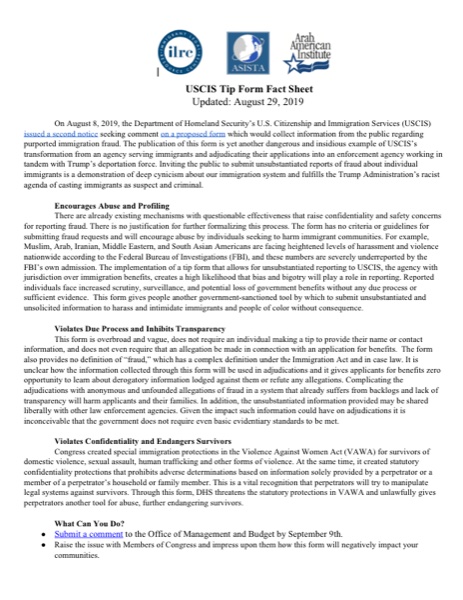
First page of the USCIS Tip Form Fact Sheet, a joint publication of ILRC, ASISTA, and the Arab American Institute, dated August 29, 2019 Open PDF →

“[The form] gives applicants for [immigration] benefits zero opportunity to learn about derogatory information lodged against them or refute any allegations. Complicating the adjudications with anonymous and unfounded allegations…will harm applicants and their families.”

— ILRC, ASISTA & Arab American Institute, USCIS Tip Form Fact Sheet (Aug. 29, 2019)

By arguing that individuals deserve basic due process — specifically notice and an opportunity to be heard — this coalition of pro-immigrant groups has unwittingly agreed with Rep. Roy: the entire U visa program violates the fundamental due process rights of the accused.

In the U visa context, the absurdity of their position is even greater. First, the entire immigration system exists to serve U.S. citizens, not to be weaponized against them. Second, U.S. citizens who are falsely accused of crimes by illegal aliens are subjected to real, damaging criminal complaints with law enforcement. Third, unlike immigrants — for whom admission to the United States is a matter of privilege, not a right — U.S. citizens accused of crimes have fundamental constitutional rights at stake.

There is also a critical asymmetry in the harm itself. The accusations against U.S. citizens that drive U visa certifications are public records — police reports, restraining orders, and criminal complaints — that follow the accused through employment screens, custody disputes, and search results. By contrast, even if an alien were falsely accused of immigration fraud, the federal Privacy Act would protect that allegation from disclosure.

When an illegal alien accuses a U.S. citizen of a crime to obtain the law enforcement certification required for a U visa, the accused citizen receives no notice that a federal immigration filing has been made naming them. The citizen has no procedure to learn what has been alleged, no procedure to respond, and no contested hearing.

Yet under the U visa program, the exact due process these advocates demand for immigrants is systematically stripped from Americans.


Take Action

Tell Congress

Support the End U Visa Abuse Act.

The bill will succeed or fail based on whether constituents ask for it. If the evidence above is persuasive to you, the single most useful thing you can do is tell your representative.

01

Sign the petition.

Add your name to a formal petition addressed to the Chairmen of the U.S. House and Senate Judiciary Committees. Codias Law will compile signatures into an endorsement letter delivered to the bill’s sponsor and committee leadership in advance of markup.

Sign the Petition →

02

Find your representatives and call.

Enter your ZIP code to pull up your two Senators and your state’s House delegation. Each comes with a phone number, contact form, and a pre-drafted message asking them to cosponsor the End U Visa Abuse Act.

Phone calls move legislation more than emails — calls are tallied, emails often are not. When you reach an office, identify yourself as a constituent, ask for the staffer who handles immigration policy, and request that the Member cosponsor the End U Visa Abuse Act. Three minutes per office. The U.S. Capitol switchboard at (202) 224-3121 also connects you to any congressional office as a fallback.

03

Share this page.

The cases are documented. The links go to DOJ, USCIS, GAO, and major outlets. Send it to one reporter, one staffer, and one ordinary citizen.

Bill Timeline

Where the bill stands.

Live from congress.gov — every committee action, cosponsor addition, and floor event as it happens.

  1. Awaiting introduction. The timeline populates live from congress.gov once the bill moves.
Take Action →